GALLERY INFORMATION GLAZES KILNS LINKS
EXHIBITIONS

These pages illustrate my recent exhibitions; I use these shows as a chance to reflect on my progress and to push my ideas forward. It is good to mount them on white plinths in a gallery to see how they stack up in that environment. However, I hope that my work looks a little uncomfortable in that white space as I never intend to make work that functions without a more immediate personal connection.

Albarellos and Tea

Duncan Shearer and Elena Renker
Form Gallery, Christchurch. July 2009

Exhibition Statement Selected Imagess
Albarello
From Wikipedia,
An albarello is a type of majolica earthenware jar originally designed to hold apothecaries' ointments and dry drugs. The development of this type of pharmacy jar had its roots in the Middle East during the time of the Islamic conquests. Brought to Italy by Hispano-Moresque traders, the earliest Italian examples were produced in Florence in the 15th century. Albarelli (plural) were made in Italy from the first half of the 15th century through to the late 18th century and beyond. Based on Persian designs said to emulate bamboo (the traditional manufacturing material), the jars are usually cylindrical with a slightly concave waist. Variations in size and style can be seen from region to region, ranging from 10cm to 40cm in height. Such jars served both functional and decorative purposes in traditional apothecaries and pharmacies, and represented status and wealth. The jars were generally sealed with a piece of parchment or leather tied with a piece of cord.

My interest in this form arose from a trip through Europe in 2007 and seeing an albarello in a Turkish museum in Istanbul. Potters in Europe also use this form as a starting point for explorations in design, decoration and form – a little like the way American potter’s picked up on the Japanese tea bowl as a starting point for personal interpretation. Back in NZ I was after a form that would suit my style of throwing and also benefit from wood firings. I kept the ideas of a strong neck, able to be closed by a parchment lid, concave sides and a variety of sizes. These limitations helped me to explore aspects of form; like the relationship between a lip and a shoulder, a lug and a handle.

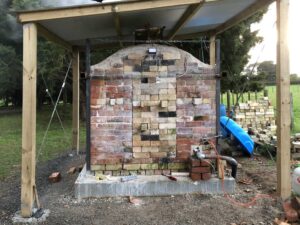
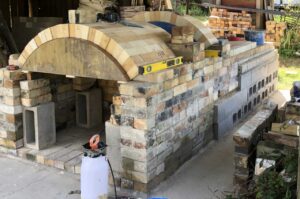
The firing of these pieces occurred in two different kilns. The first was an anagama firing that lasted almost 4 days and layered up a rich surface of ash. The second was a fast firing in a wood kiln – only 9.5 hours, but I also added soda ash during the end of the firing to assist with creating colour. Some of the pots have shell remains imbedded in their sides from the way I stacked them in the kilns. This is deliberate and I use this method as a way of creating interesting surfaces.